

Service-Disabled Veteran-Owned Small Business (SDVOSB)

Select Anchor Elite, LLC
When Upgrading to Venturi Traps
Anchor Elite, LLC is a distributor for ENERCON SYSTEMS COMPANY, a Steam Specialist in the State-of-The-Art Steam Condensate Removal System and fixed venturi nozzle technology. ENERCON is a boiler to Return line Steam Specialists. Some steam systems can be sized off site with all pertinent data supplied to the local distributor. Others require a Steam System Review including conventional steam traps to be conducted. ENERCON can improve your existing steam system, explain the venturi trap and/or provide information for your review. Used in a wide variety of industries, no steam job is too small or large. The greatest benefits being with total conversions. Pay back of one year or less is not uncommon in upgrading from conventional steam traps. It is possible to simply replace blown mechanical steam traps with the permanent multi-stage with venturi tube, and prevent unplanned downtime. The best location to start conversion, is usually at the main steam header. President Carter awarded a civil engineer with the US NAVY for saving $10,000,000.00 in fuel in a single year by replacing conventional steam traps with venturi orifice steam traps. Replacing conventional traps in 4-5 year intervals was ELIMINATED, and removing the repetitive installation costs for welded traps. These additional cost savings of $100 per year per trap, for a total FLEET cost savings of $15,000,000.00 per YEAR. All costs have increased since that time, therefore saving are also greater. A good reference on steam in general with Chapter 6 detailing steam using sharp edge venturi trap is Steam Trap Hand Book.

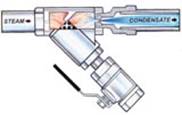
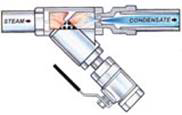
LOW PRESSURE ASSEMBLY ( 22 SIZES) INCLUDES:
- 1. STEAM ORIFICE WITH LIFETIME WARRANTY
- 2. Y-STRAINER
- 3. NIPPLE
- 4. BLOW DOWN VALVE
Anchors Aweigh with Your Problems!Top
Steam Trap History
Over 35 years ago, the US Navy had investigated steam trapping techniques in order to cut down on their steam trap operation and maintenance costs. After EIGHT YEARS (8) of testing, it was reasoned and determined by the US Navy, the non-mechanical trap produced the least steam loss over all other conventional steam traps tested. In fact, steam losses with the non-mechanical trap was minute. Reliability, and efficiency being of prime importance, they wanted equipment that will function reliably while deployed at sea. There was unquestionable evidence of the large energy savings. The researchers included in their testing of the non-mechanical trap in the following industries: Petrochemical Paper Steel Manufacturing Pharmaceutical Textile Industries Heating & Air Conditioning of Buildings
The US Navy was so extremely impressed with the researchers work with the non-mechanical trap, they outfitted their ENTIRE FOSSIL FUEL FLEET of OVER 300 SHIPS, at the time. The FLEET expeditiously moved to buy material to install orifices FLEET WIDE. Testing was done on the following SHIPS:
USS SARATOGA
USS CONSTELLATION
USS AMERICA
USS KENNEDY
USS INTREPID
It is not too hard to understand the skepticism with regards to the non-mechanical trap's performance. It appears too simple and "TOO GOOD TO BE TRUE". It is relatively simple, but with the advanced technology, new materials, engineering and a better understanding of steam systems, it has made the non-mechanical trap effective. There is substantial data accumulated regarding the performance of non-mechanical trap in condensate removal systems.
In plants with large steam consumption, the results are even more dramatic. In many cases, the total cost of CONVERTING the steam traps to non-mechanical trap was less than the fuel savings for ONE MONTH. With the added benefit of elimination of maintenance costs. A good reference on steam in general with Chapter 6 detailing steam using non-mechanical trap is The Steam Trap Handbook.
TopSteam Trap Benefits
Some fixed venturi orifice traps are deemed permanent systems and carry a lifetime warranty through their manufacturers. Some other similar systems have life expectancies of approximately much less than 10 years. That fact in itself, is a major reason to install the venturi trap instead of the mechanical trapping system being utilized in many industries. The fixed venturi trap can be used in any industry using steam. Since the fixed venturi trap can handle variable loads and can accommodate wide load changes if the system has a modulating control valve, it is recommended for a wide variety of industries. A constant pressure drop across the trap prevents over pressuring down-stream condensate systems. For this reason, the utility industry (independent power producers) have adopted the venturi steam trap, excluding most conventional traps. It would be appropriate for new and old industrial facilities to implement the Venturi System. Venturi can effectively replace single blowing mechanical traps. Apply to main header, drip legs, tracing lines, rail car lines, or a heating system.
Top
Technical
Inlet Steam Pressure Variations:
The basic laws of thermodynamics applies. With the drop in pressure, in saturated conditions, there are a number of property changes, including temperature and specific volume. Temperature has a direct influence in heat loss from the steam line Pressure & Volume are important factors in the determination of orifice capacity: THE END RESULT is a compensation by the venturi trap. With regard to the changes in conditions. The loads decreases more than the capacity of the venturi trap decreases, therefore the venturi trap will have no problem performing just as efficiently at the reduced pressure.
Back Pressure Variation:
Only a few major factors influence large fluctuations in back pressure
1. Basic error of assumptions.
2. Addition of equipment which causes an overload of an existing system.
3. Steam trap failure. A chain reaction develops with failed traps leading to the loss of efficiency of other steam traps discharging into the same system as the failed trap, and their premature eventful failure. All causing slowed production rates. The venturi trap is an obvious solution and improvement as it cannot fail open and overload the exhaust system. Also, with the venturi trap it can be accurately predicted discharge flows. Condensate is continually removed through the venturi trap, which has a 25% safety factor. This increases the discharge rate, resulting in a lower saturation level. The reduced saturation level allows higher temperatures and more efficient heat transfer. Under identical conditions, a typical mechanical trap discharges about 6 times per minute, 3 seconds per discharge. Which means it operates 30% of the time. Even when the condensate load is at 25% of maximum capacity, the ENERCON Assembly unit loses only 40% of what a MECHANICAL trap loses. The ENERCON ASSEMBLY is a far better choice.
TopSteam Trap Industries
Aircraft Factories, Asphalt Plants, Bakeries, Battery Manufacturing, Breweries, Candy Factories, Chemical Processing Plants, Cleaning & Purifying Equipment, Corrugators, Creameries & Instant Milk Producers, Uniform Co., Waste Facilities, Water Bottling Plant, Lumber Mills, Dairies, Development Activities, Dry Cleaners, Electric Generating Companies, Experimental Activities, Feed Mills, Fertilizer Plants, Floor Manufacturers, Flour Mills, Food Processing Plants (Canning & Freezing) Soda Water Bottling Plants, Steel Mills, Tanneries, Tool Making Plants, Foundries, Fuel & Electricity Producers, Furniture Factories, Glass Making Plants, Hospitals, Laboratories, Laminators, Laundries, Limestone, Calcination Plants, Lumber Mills, Pharmaceutical Co., Platers, Printers, Refineries, Restraunts, Machine & Equipment Producers, Malting Plants, Meat Packing & Processing Plants, Metal Finishers, Motel & Hotels, Motor Vehicle Factories, Nursing Homes, Oil Refineries, Paint Factories, Paper Making Plants, Schools and Heating Systems.
FINISHERS MANAGEMENT - Magazine
Finishers' Management is the management magazine of the surface finishing industry, providing in-depth, authoritative information on all aspects of metal finishing for the "movers and shakers" who are also the present and future leaders of this industry. Finishers' Management is of particular interest to those on the "cutting edge" of metal finishing ... providing information on the latest technology while always keeping an eye on the bottom line. The August 2001 issue includes a description of benefits of ENERCON ASSEMBLIES, venturi trap; Enercon Systems Company produces the Enercon assembly, which includes a stainless condensate removal unit (with lifetime warranty), Y-strainer and blow down valve, is a permanent replacement for mechanical steam traps. Installed in 130 plating companies, it has typically resulted in 15 percent to 30 percent fuel savings, faster startups, substantially lower makeup water requirements and virtual elimination of steam trap maintenance. An advertisement in the August 2001 issue includes the following: Customers with systems as long as 10 years have never replaced an Enercon unit. As an integral part of every installation, Enercon conducts a steam system analysis and trap survey. This includes evaluation of steam pressure, carryover, insulation, separator, boiler chemicals, condensate, piping, insulation, and problems such as pressure drops, inconsistent temperatures, slow startups and water hammer. Click following for Finishers’ Management home: http://www.finishers-management.com/index.htm
Use Steam?

This Little Device Has Cut Fuel Costs in Many Plants by 15%-25%
Two inches long and about six ounces. The thousands Enercon Systems Company has installed in industries through it’s distributor network since 1989 have helped make the steam systems of 135 platers more productive and fuel-efficient. Our unit does what mechanical steam traps are supposed to do for a steam system — get water out efficiently and keep steam in. Difference is ours is one piece. No moving parts cycling millions of times a year. No wear. No steam leaks. It’s permanent and it’s benefits are permanent. Example: In 1996, we saved the largest privately owned U.S. plater Anchors Aweigh with Your Problems!
Top